Diagnosis-led Revenue Intelligence.
For fractional executives, interim leaders, and consultants whose revenue depends on reading the account correctly before the engagement begins.
Not a platform. Not an agency. An external read before you commit your capacity.
Clarity before commitment.
For the right operator, the job is precise: narrow attention to accounts where the problem is already visible, test whether the signal is strong enough to act on, and have the read complete before anyone reaches out.
What it does
It tells you whether an account deserves 25 hours of your time before you spend them. Not by checking whether they fit a list. By reading whether the wound is active, whether the timing is real, and whether you are the right move at all.
What it won't do
It does not spray generic sequences, hide the relationship, pretend to be partner staff, or push weak-fit accounts forward just to create activity.
What a bad pursuit actually costs.
For buyers whose decisions are ROI-based, evidence-hungry, and time-constrained, the cost of the wrong engagement is not abstract. Here it is, by profile.
Modelled from public compensation, fee and placement benchmarks. The mechanism is stated in each row so the arithmetic can be checked or disputed.
| Operator | Cost Range | Mechanism |
|---|---|---|
| Solo Fractional CMO | $40k–$75k | One wrong engagement consumes the capacity slot for an entire quarter. The cost is not the wasted hours; it is the right client you were unable to take. |
| Boutique GTM Consultant | $25k–$75k per pursuit | 20–40 partner hours per proposal at $300–$500/hour. A bad pursuit costs this before the first SOW is written, with no recoverable asset at the end. |
| Interim / Turnaround Executive | $45k–$90k per failed engagement | When average tenure drops below 9 months, search firms reduce placement frequency. At $15k–$30k per placement fee, two failed engagements removes one from the referral rotation permanently. |
| PE Operating Partner | 0.3x–0.5x exit value at risk | A $500k–$2M value-creation deployment into a company that cannot absorb the intervention reduces exit multiple rather than improving it. The cost is not the fee. It is the multiple. The 0.3x–0.5x range is a stated modelling assumption drawn from value-creation deal benchmarks, not a measured figure. At $750, the pilot is a rounding error against a $500k–$2M deployment. |
| M&A Diligence Advisor | 40–80 partner hours lost | The diligence window is fixed. Hours spent discovering what should have been visible before the LOI are hours not spent on issues that would have changed the deal structure. |
| Executive Coach / CEO Advisor | $60k–$300k retainer burn | A CEO who wants validation, not challenge, ends the engagement and stops the referral chain. The retainer burn is recoverable. The referral decay is not. |
A PARK verdict is the return, not a failed output. For the Solo Fractional CMO, it saves the $40k–$75k capacity slot. For the PE Operating Partner, it protects the 0.3x–0.5x exit multiple. For the Executive Coach, it prevents the referral decay that outlasts the retainer. The stop signal scales to the profile.
At $1,500 a verdict, the read is between one and four percent of the wrong-pursuit cost it prevents.
That ratio is the whole case for buying it.
Neither platform nor agency.
The platforms tell you who is in-market based on signals. They don't tell you what's actually wrong with the account. The agencies handle execution; intelligence is incidental to their service, not the product. toog Revenue Intelligence sits in the space neither occupies: deeper than any platform, more intelligence-focused than any agency. And for operators who work alone, without a research team, a junior analyst, or the capacity to read 30 accounts before committing to one, it functions as a surrogate judgment layer before the first call. The question it answers isn't "who should we call?" It's "what is broken, and is it broken enough to act on now?"
Six kinds of operator. One structural problem.
Their offers are different. Their buyers are different. The wound is the same: their product is the quality of their judgment before the engagement begins. A wrong one doesn't just waste time. It fails the product.
Solo Fractional CMO
2–3 client max. One bad pursuit costs more than time. It costs the quarter you didn't take the right client. You need the read before you book the call.
Boutique GTM Consultant
A 2–10 person firm where proposal hours are the scarcest thing you have. The discovery call is starting to do more work than the engagement. That math is already broken.
Interim or Turnaround Executive
Your brand is your success rate. One failed tenure follows you to the next placement, especially where the CRO and CPO were at war and you should have known on the first call.
PE / VC Operating Partner
You're pattern-matching across a portfolio. The cost of a wrong intervention isn't a proposal. It's a multiple. You need the commercial read before you allocate the resource.
M&A or Commercial Diligence Advisor
Partner time is the unit of value. When the due diligence window opens, you can't spend it discovering what should have been visible before the LOI.
Executive Coach or CEO Advisor
Your value is in the room, not the research. But the wrong advisory relationship, where the CEO just wanted validation, damages the one thing you can't replace: your track record of being right.
You name the account.
Or you hand us the profile and we find them.
Both run the same verification pass. Both end in a verdict you can act on. The difference is only whether the account starts on your desk or ours.
You already have a target.
You tell us who, and we tell you whether it's worth 25 hours of your time: the wound, the timing, and whether you're the right move at all. One account, one verdict: pursue or park.
You don't have a target yet.
You have a profile of who you serve. You hand us that, and we go find the right-fit accounts, screen the field, and return each one with a verdict. Not a list of names. A screened field, every candidate read and graded, the ones to chase and the ones to leave, each with the reason.
Four moves. One cleaner conversation.
Each step is executed in sequence, designed to protect the partner's time and the integrity of the handoff.
Check the fit
Before the hunt starts, we check whether the offer, partner motion, and commercial reality are clean enough to justify the work at all.
What this prevents: spending 30 hours pursuing an archetype toog can read but your offer cannot currently serve.
Read the signals
We look for accounts where the problem is already leaking into public traces, not just names that fit a list.
What this prevents: walking into a discovery call on an account whose wound you won't see until month three.
Build the case
We turn those signals into an answer-first account case, with timing, owner path, and supporting traces clear enough to use.
What this prevents: writing a proposal for a company whose real problem is outside your scope.
Know before you commit
When the signal survives scrutiny, the next move is warmer. When it does not, the work still saves the capacity, the proposal hours, and the quarter.
What this prevents: the quarter lost to an engagement that was wrong from the first call.
Two phases, one gate.
Source only runs on a locked profile. A vague sense of "who we serve" produces a vague field, and a vague field wastes your money downstream. So we stage it, and you can stop after the first phase.
Profile Lock
We turn your sense of who you serve into a locked ICP: the segment, the qualifying signals, the disqualifiers, and the wound that makes an account worth pursuing. We run our verification pass on your inputs before we lock. If what you've given us can't support a clean profile, we tell you that in Phase 1 rather than discovering it fifteen hours into Source work.
A complete deliverable on its own. You can take the locked profile and run your own outreach against it. Many will.
Phase 1 produces a lockable profile, or it surfaces exactly why the inputs can't support one. Either outcome is worth having before a dollar goes into discovery.
Source Sprint
On a locked profile, one we built or one you bring that survives our verification pass, we discover the field, screen it, read each credible candidate, and return the Field Report: every account graded, ROUTE or PARK, with the reasoning attached.
If you arrive with a profile already locked and it survives our pass, you skip Phase 1 and pay only for Source. If you don't, Phase 1 comes first. We won't run Source on a profile we can't stand behind.
The Field Report.
Not a list. A screened field, with the whole funnel visible.
The Field Header
How many candidates we surfaced, how many cleared the credibility bar and were read, and the split. "Surfaced 30, read 11, 4 ROUTE / 7 PARK." You see exactly what your fee bought.
ROUTE Accounts
Each with the full read: Evidence Pack and Deployment Intelligence, the same standard as our published specimens. The accounts to pursue now.
PARK Accounts
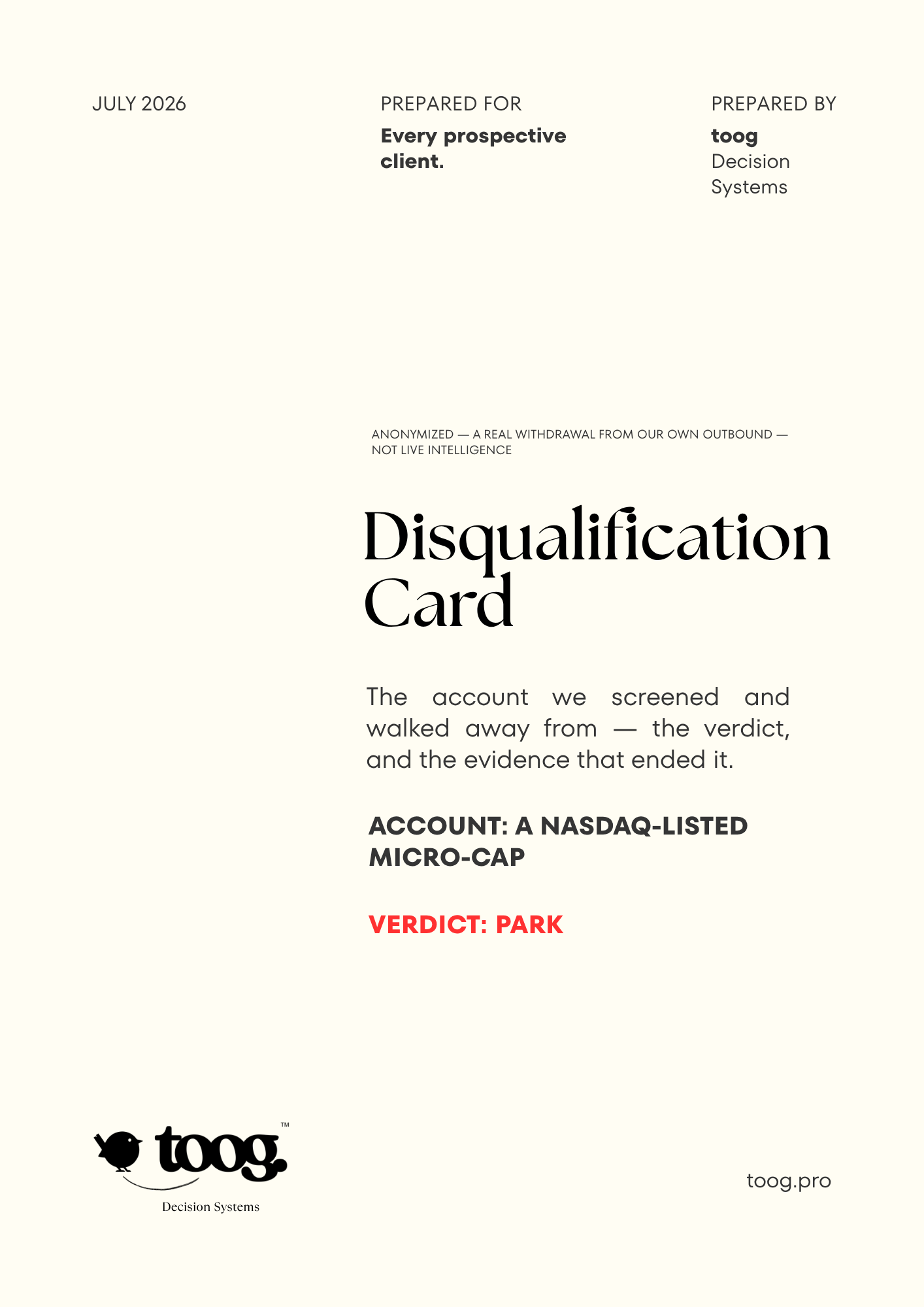
Each with a Disqualification Card: the account, the wound we checked, the specific reason it didn't clear, and the one condition that would flip it to ROUTE later. A parked account isn't a dead account. It's a watch-list entry with a named trigger.
Every account is a delivered verdict, ROUTE or PARK, and every verdict is priced the same. A PARK takes the same verification pass as a ROUTE and prevents a more expensive mistake. The verdict is the product, not the colour of the light.
Specimens.
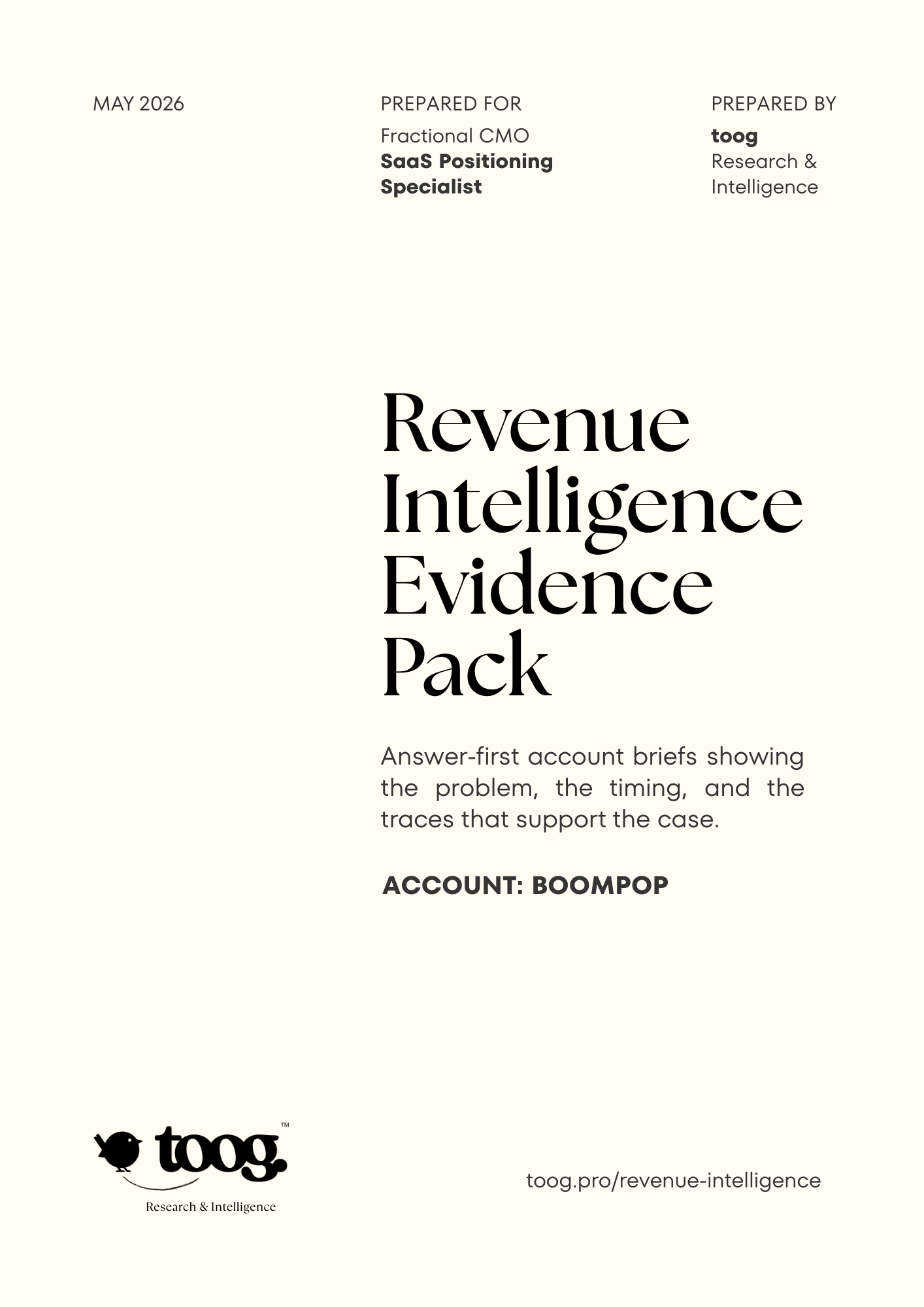
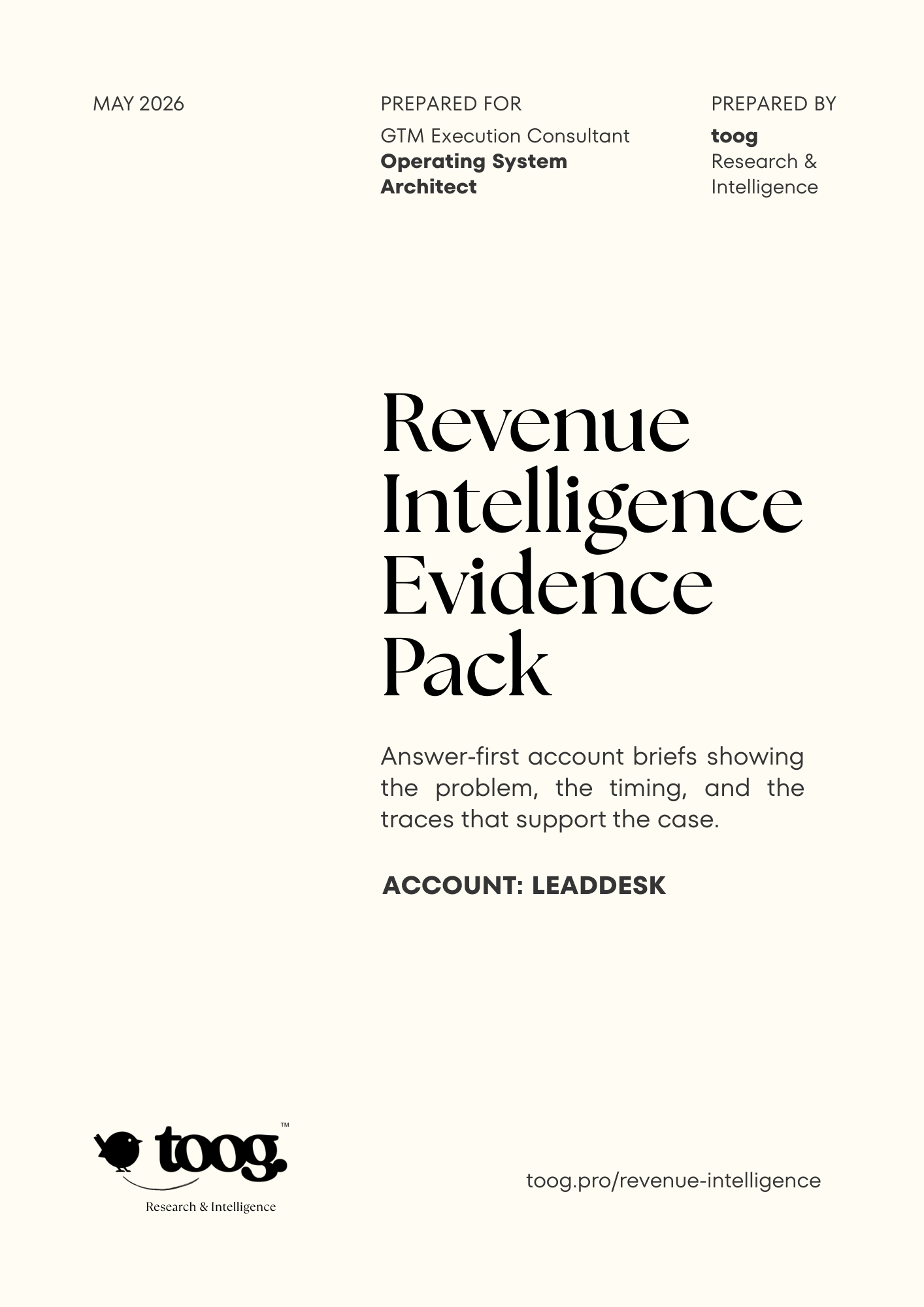
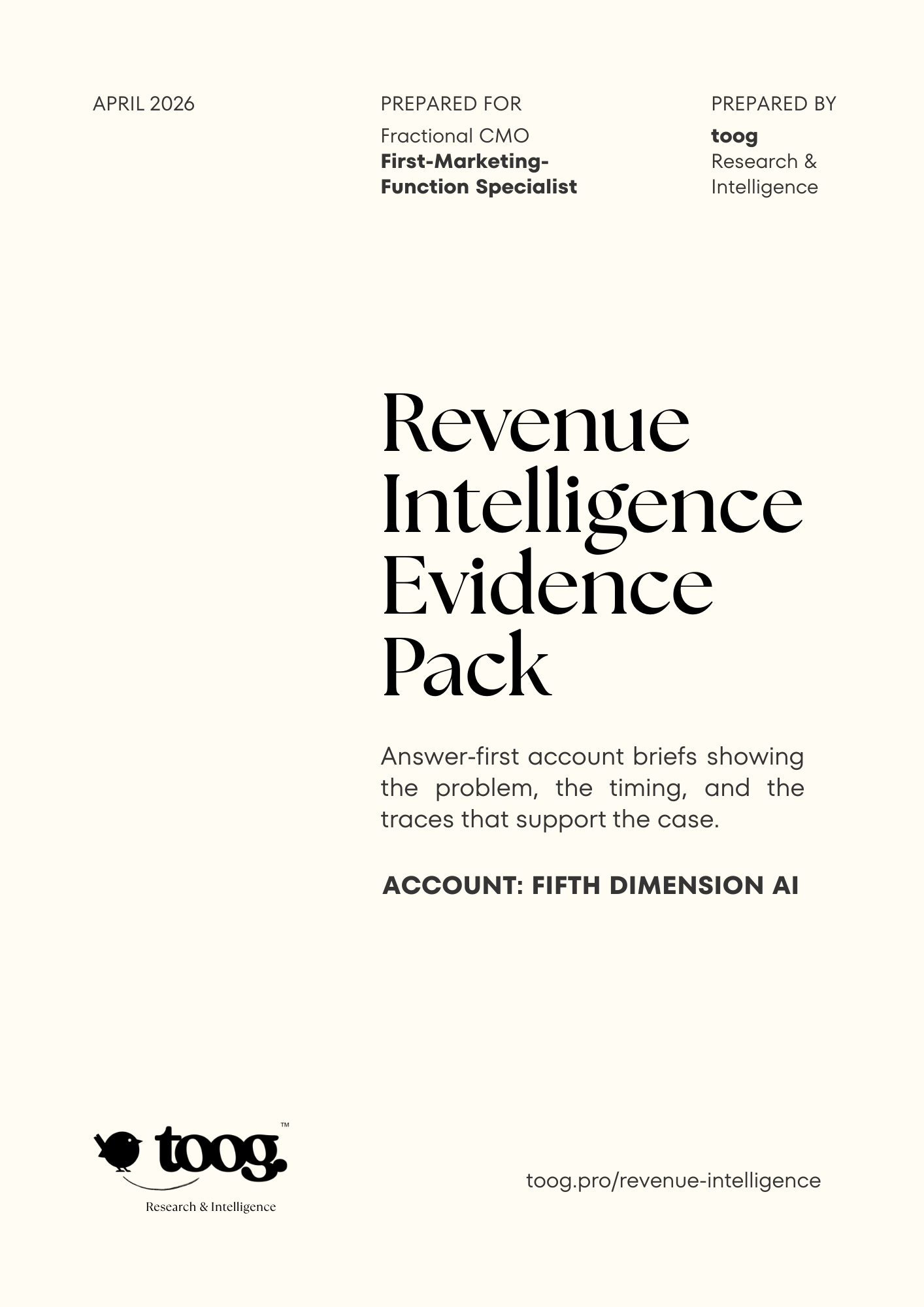
Three Evidence Packs we delivered, and one card that never became one. Read the excerpt. Download the full document.
Each specimen states the date its evidence was verified, and we do not re-date them. A read is a photograph of a decision window, not a live feed. If the window has moved, that is itself part of what the pack is showing you.
What it costs.
Every price is flat and quoted before we start. Payment is on acceptance, including when the verdict is don't pursue. A read that stops a pursuit has changed your decision; that's the return, and it's billable. A read you look at and shrug at hasn't, and we'd rather not be paid for it.
One account, a one-page signal, no call. Our sample and your test. Returns in 48–72 hours.
Three account verifications at an onboarding rate held far below standard, so a first engagement costs almost nothing to test. One per client, once.
You name the account. We return the verdict: pursue or park, cited and graded.
Phase 1, standalone or as the gate before Source. A locked ICP you can act on with or without us.
On a locked profile, a screened field with every candidate read and graded. Priced per delivered verdict, ROUTE or PARK. A ten-candidate field runs to roughly $15,000, against a wrong-pursuit cost this line puts at $40,000 to $300,000.
Source running continuously against a standing profile. The per-verdict rate drops because the profile is already locked and the vertical knowledge already built, a real saving, shared. The longer it runs, the sharper the reads get, because we know your field better every month.
Not built for every operator.
The line works best when the operator values cleaner judgment more than raw activity.
Not a fit
- ✕You want hidden identity or partner-staff roleplay
- ✕You want every account pushed forward regardless of signal quality
- ✕You measure value only by meeting count
- ✕You want this to behave like generic lead generation
A fit
- ✓Your capacity is limited: 2–3 active clients, a 6-month mandate, or a partner-team at full plates. One wrong account costs a quarter, not just a week
- ✓You've spent time on a client who needed something outside your scope and knew it too late
- ✓You write proposals or scopes before you have enough information to write them well
- ✓You want a read on the account before the first call, not a report after the third
- ✓You can accept that some accounts should be left alone. That conclusion is valuable, not wasteful
What the partner gets.
A short set of usable artifacts. No activity theater. The work ships as concrete materials the partner can actually use.
Evidence Packs
The read you needed before the first call: what's actually wrong, whether the timing is real, and whether you are the right move right now.
Message Logic
If the account survives scrutiny, the opening logic is built from what is specifically true about this account, not from a template pasted across a list. For operators who reach out directly, or partners who do.
Handoff Briefs
When the case is strong enough to move, the logic that earned the conversation is explicit, for whoever reaches out, in whatever form that takes.
And sometimes the most valuable output is a stop signal.
The signal is weak, the timing is wrong, or you are not the right first move. For operators whose revenue runs on judgment before commitment, walking away with that verdict is the return.
toog doesn't generate leads. It generates legibility.
It takes an invisible wound and makes it visible: first to itself, then to the right practitioner, and finally to the buyer in language that makes them feel genuinely understood for the first time.
Start with one account.
Name one account you're considering. We'll return a 1-page signal read: free, bounded, no call required. Or request a full partner review to explore fit before naming an account.